
Bringing Design Consistency to NEOM at Scale
Bringing Design Consistency to NEOM at Scale
Bringing Design Consistency to NEOM at Scale
8 min est. read

View Figma File
*Figma file available to view on desktop.
Overview
NEOM's digital campaigns were reaching 200,000 registered users monthly across Arabic and English markets. A single newsletter dispatch alone reached over 62,000 subscribers simultaneously across both languages.
But every campaign was a one off. Approved designs rarely matched what went live. At that scale, inconsistency was not just a production problem. It was a trust problem.
My Role
Lead Designer
Responsibilities
Research
Design Systems Strategy
Execution
Timeline
Q3 2024
Impact Snapshot
Impact Snapshot
-0%
-0%
-0%
Dev QA cycles
Dev QA cycles
+0%
+0%
+0%
Faster campaign rollout
Faster campaign rollout
The Solution
A look at the final designs before we get into how it came together.
A look at the final designs before we get into how it came together.

The Challenge
Every campaign started from zero. Without a shared design language, developers estimated values rather than reading them. Inconsistencies compounded across every build cycle. Arabic was treated as a translation layer rather than a design problem, which meant RTL layouts were mirrored rather than intentionally rethought. At NEOM's scale, running concurrent campaigns across two language markets without a scalable foundation, this was not sustainable.
Every campaign started from zero. Without a shared design language, developers estimated values rather than reading them. Inconsistencies compounded across every build cycle. Arabic was treated as a translation layer rather than a design problem, which meant RTL layouts were mirrored rather than intentionally rethought. At NEOM's scale, running concurrent campaigns across two language markets without a scalable foundation, this was not sustainable.
Discovery
A system built from vague requirements gets rebuilt within a quarter. A system worth building starts with knowing exactly what needs to be reusable, and that's what the discovery phase was for. Before any system work began, the existing data told part of the story, four distinct audiences, visitors, residents, investors, and tenants, each reading campaigns differently depending on intent.
A system built from vague requirements gets rebuilt within a quarter. A system worth building starts with knowing exactly what needs to be reusable, and that's what the discovery phase was for. Before any system work began, the existing data told part of the story, four distinct audiences, visitors, residents, investors, and tenants, each reading campaigns differently depending on intent.

With the journey aligned internally and with NEOM, mapping wireframes against that data was the next step, but it took direct sessions with subscribers, internal teams, and NEOM's points of contact, run in several rounds, before templates were locked.
With the journey aligned internally and with NEOM, mapping wireframes against that data was the next step, but it took direct sessions with subscribers, internal teams, and NEOM's points of contact, run in several rounds, before templates were locked.

Once each template held up across those sessions, the work moved to look and feel, a harder problem than it sounds for a brand that needed to read as genuinely premium at global scale. With templates locked and direction approved, the actual system architecture could begin, built on validated decisions rather than assumptions.
Once each template held up across those sessions, the work moved to look and feel, a harder problem than it sounds for a brand that needed to read as genuinely premium at global scale. With templates locked and direction approved, the actual system architecture could begin, built on validated decisions rather than assumptions.
Key Decisions
Concepts Before Components
Building a system before creative direction was approved would have meant investing engineering time into structure nobody had agreed on yet. Locking direction first, then building the system around it, protected against the real cost here: rework compounding across every revision cycle once stakeholders started disagreeing with an already-built system.
Concepts Before Components
Building a system before creative direction was approved would have meant investing engineering time into structure nobody had agreed on yet. Locking direction first, then building the system around it, protected against the real cost here: rework compounding across every revision cycle once stakeholders started disagreeing with an already-built system.
Iterative Over Complete
A complete library delivered upfront was months of investment before any campaign benefited from it, and it risked containing components nobody ended up needing. Building iteratively meant every piece added was already proven to be used, turning this into a lower risk, faster payback decision rather than a single large bet.
Iterative Over Complete
A complete library delivered upfront was months of investment before any campaign benefited from it, and it risked containing components nobody ended up needing. Building iteratively meant every piece added was already proven to be used, turning this into a lower risk, faster payback decision rather than a single large bet.
Figma Dev Mode as the Communication Bridge
Every inconsistency between what was approved and what shipped was quietly costing rebuild time and eroding trust between design and engineering. That wasn't a tooling gap, it was an accountability gap with no shared source of truth. Figma Dev Mode closed it, removing the recurring cost of developers guessing instead of reading.
Figma Dev Mode as the Communication Bridge
Every inconsistency between what was approved and what shipped was quietly costing rebuild time and eroding trust between design and engineering. That wasn't a tooling gap, it was an accountability gap with no shared source of truth. Figma Dev Mode closed it, removing the recurring cost of developers guessing instead of reading.
RTL as a Design Problem
Arabic wasn't a formatting problem, it was 100,000 plus monthly users being served an afterthought. Designing RTL in from the start, rather than retrofitting it later, was a call to treat that audience as a first class requirement rather than a cost saved by deferring it.
RTL as a Design Problem
Arabic wasn't a formatting problem, it was 100,000 plus monthly users being served an afterthought. Designing RTL in from the start, rather than retrofitting it later, was a call to treat that audience as a first class requirement rather than a cost saved by deferring it.
Built for Every Surface and Language
Shipping English desktop first and adapting later would have meant every other variant was permanently a step behind and under tested. Requiring desktop, mobile, Arabic, and English as one scope from day one meant the system covered the actual business, not just the easiest slice of it, from the start.
Built for Every Surface and Language
Shipping English desktop first and adapting later would have meant every other variant was permanently a step behind and under tested. Requiring desktop, mobile, Arabic, and English as one scope from day one meant the system covered the actual business, not just the easiest slice of it, from the start.
Atomic Design Approach
Components were built across four levels, atoms, molecules, organisms, and templates, each layer composing from the one below it. Nothing was built in isolation. A button defined at atom level informed every form, card, and campaign template above it. This meant a single token update could propagate correctly across the entire system without manual intervention at every level.
Components were built across four levels, atoms, molecules, organisms, and templates, each layer composing from the one below it. Nothing was built in isolation. A button defined at atom level informed every form, card, and campaign template above it. This meant a single token update could propagate correctly across the entire system without manual intervention at every level.

Two Libraries, One Unified Framework
Two Libraries, One Unified Framework
EDMs and Cloud Pages have different layout constraints, rendering environments, and interaction patterns. Building them into a single library would have forced compromises that served neither surface well. Two separate libraries, each optimised for its context.
EDMs and Cloud Pages have different layout constraints, rendering environments, and interaction patterns. Building them into a single library would have forced compromises that served neither surface well. Two separate libraries, each optimised for its context.

Design Documentation
Design Documentation
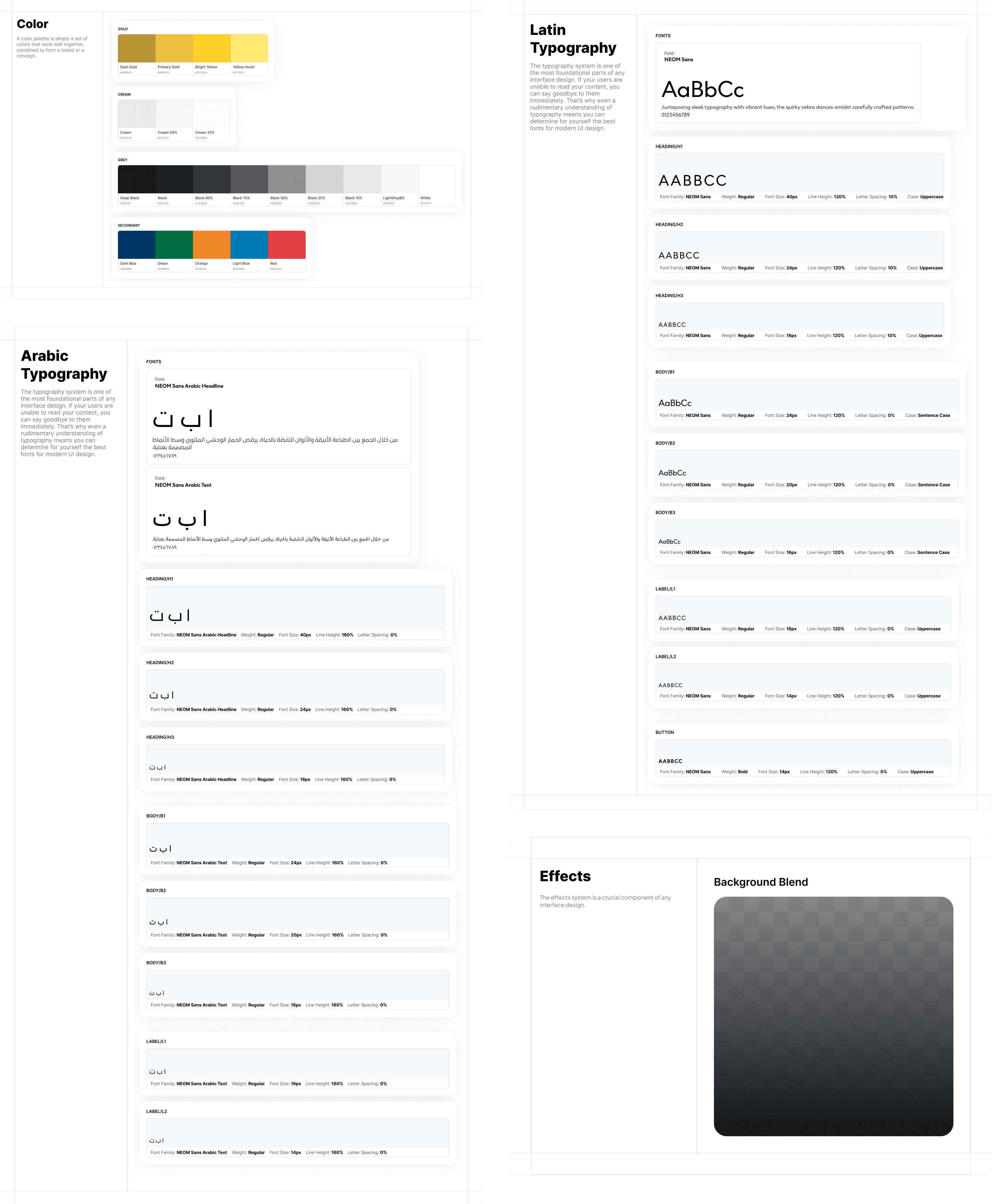
Every token, component, and pattern was documented with usage guidelines and exact specifications. Latin and Arabic typography scales were documented separately, with Arabic hierarchies defined for RTL reading patterns rather than derived from Latin scales. Developers had a reference that removed ambiguity from every build decision.
Every token, component, and pattern was documented with usage guidelines and exact specifications. Latin and Arabic typography scales were documented separately, with Arabic hierarchies defined for RTL reading patterns rather than derived from Latin scales. Developers had a reference that removed ambiguity from every build decision.
Component Structure
Component Structure
Components were built across four levels, atoms, molecules, organisms, and templates, each layer composing from the one below it. Nothing was built in isolation. A button defined at atom level informed every form, card, and campaign template above it. This meant a single token update could propagate correctly across the entire system without manual intervention at every level.
Components were built across four levels, atoms, molecules, organisms, and templates, each layer composing from the one below it. Nothing was built in isolation. A button defined at atom level informed every form, card, and campaign template above it. This meant a single token update could propagate correctly across the entire system without manual intervention at every level.


Built for every use-case
Built for every use-case
NEOM's campaigns span multiple formats, hero announcements, event promotions, product launches, and community updates. A rigid component set would have broken under that variety. Every component was built with configurable properties, allowing teams to adapt layouts, toggle content sections, and switch between language directions without rebuilding from scratch. Flexibility was not a nice to have. At NEOM's campaign velocity it was a requirement.
NEOM's campaigns span multiple formats, hero announcements, event promotions, product launches, and community updates. A rigid component set would have broken under that variety. Every component was built with configurable properties, allowing teams to adapt layouts, toggle content sections, and switch between language directions without rebuilding from scratch. Flexibility was not a nice to have. At NEOM's campaign velocity it was a requirement.

Every token, component, and pattern was documented with usage guidelines and exact specifications. Latin and Arabic typography scales were documented separately, with Arabic hierarchies defined for RTL reading patterns rather than derived from Latin scales. Developers had a reference that removed ambiguity from every build decision.
NEOM's campaigns span multiple formats, hero announcements, event promotions, product launches, and community updates. A rigid component set would have broken under that variety. Every component was built with configurable properties, allowing teams to adapt layouts, toggle content sections, and switch between language directions without rebuilding from scratch. Flexibility was not a nice to have. At NEOM's campaign velocity it was a requirement. The system was built. What mattered next was whether it held up outside a controlled environment.
Every token, component, and pattern was documented with usage guidelines and exact specifications. Latin and Arabic typography scales were documented separately, with Arabic hierarchies defined for RTL reading patterns rather than derived from Latin scales. Developers had a reference that removed ambiguity from every build decision.
NEOM's campaigns span multiple formats, hero announcements, event promotions, product launches, and community updates. A rigid component set would have broken under that variety. Every component was built with configurable properties, allowing teams to adapt layouts, toggle content sections, and switch between language directions without rebuilding from scratch. Flexibility was not a nice to have. At NEOM's campaign velocity it was a requirement. The system was built. What mattered next was whether it held up outside a controlled environment.
Validation
Every template and look-and-feel direction went through multiple rounds of testing, sessions with NEOM's team and with users themselves, not just internal sign-off. That iteration continued until templates held up in practice, and once locked, the system began rolling out across every live campaign, the same system carried from discovery through to production. The 25% faster rollout and 40% fewer QA cycles are figures measured six months after full adoption, not projected at launch.
Every template and look-and-feel direction went through multiple rounds of testing, sessions with NEOM's team and with users themselves, not just internal sign-off. That iteration continued until templates held up in practice, and once locked, the system began rolling out across every live campaign, the same system carried from discovery through to production. The 25% faster rollout and 40% fewer QA cycles are figures measured six months after full adoption, not projected at launch.
Impact
Impact
-0%
-0%
-0%
Dev QA cycles
Dev QA cycles
+0%
+0%
+0%
Faster campaign rollout
Faster campaign rollout
Learnings
The most persistent design problems are usually communication problems in disguise. Visual inconsistency was the symptom. The real issue was that design and engineering had no shared language. The system solved that. Consistency followed.
Bilingual design cannot be retrofitted. Building Arabic in from the start was not more work. It was less work across the entire project lifetime.
A system is only as valuable as the engineering relationship behind it. The library could have been perfect and still failed if developers did not trust what they were reading. Adoption follows trust, not completeness. That's the throughline from discovery to launch: every decision earned its place by surviving contact with real users, real engineers, and real campaigns.
The most persistent design problems are usually communication problems in disguise. Visual inconsistency was the symptom. The real issue was that design and engineering had no shared language. The system solved that. Consistency followed.
Bilingual design cannot be retrofitted. Building Arabic in from the start was not more work. It was less work across the entire project lifetime.
A system is only as valuable as the engineering relationship behind it. The library could have been perfect and still failed if developers did not trust what they were reading. Adoption follows trust, not completeness. That's the throughline from discovery to launch: every decision earned its place by surviving contact with real users, real engineers, and real campaigns.