
Launching Kia’s First Pickup Truck in the Middle East
Launching Kia’s First Pickup Truck in the Middle East
Launching Kia’s First Pickup Truck in the Middle East
7 min est. read

Overview
Kia Tasman was Kia's first pickup truck launch in the Middle East. The truck had already launched in Korea, but almost nothing from that setup transferred. Korean assets couldn't be licensed to the region, 3D renders had to be created from scratch in parallel, and the microsite and configurator had to feel like one connected journey despite being built as two separate surfaces.
The harder problem was that Middle East truck buyers aren't Korean truck buyers. Understanding that difference shaped everything that followed.
I led the work end to end, from research and structure through experience direction across both surfaces, delivered in English and Arabic with full RTL support.
My Role
Senior Product Designer
Responsibilities
User Research
0 to 1 Experience Design
Timeline
Q1 2025
Outcomes
Outcomes
Regional First
Kia's first pickup truck experience built for the Middle East market
Minutes, Not Days
Component library let 3D asset corrections be swapped across the entire configurator in minutes
Seamless Handoff
Two surfaces shared language, patterns, and flow, so users moved from discovery to configuration without feeling the seam
The Solution
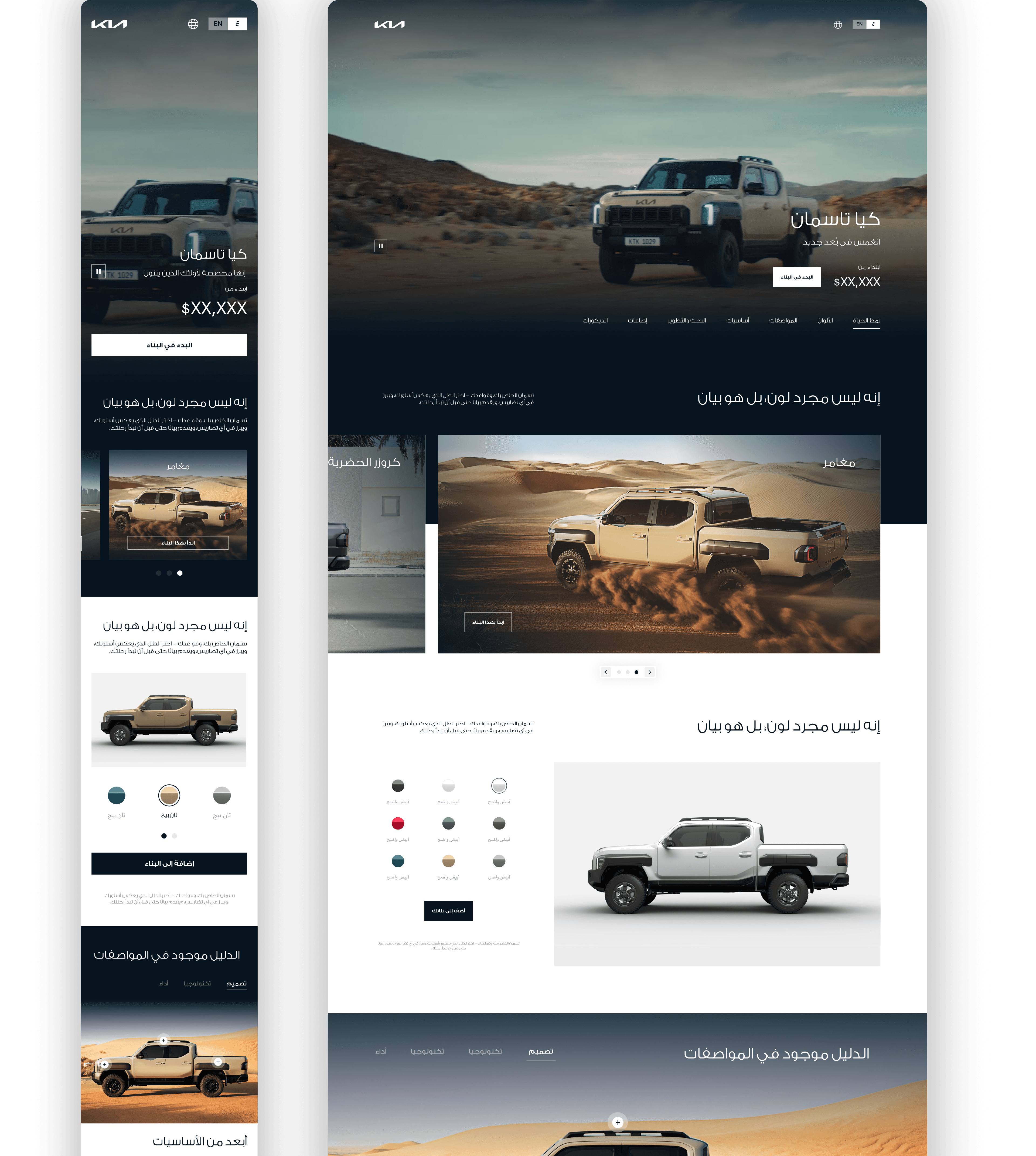
A look at the final design before we get into how it came together.
A look at the final design before we get into how it came together.
The Challenge
Three things made this launch genuinely difficult.
A new category with no regional reference
Nobody in the Middle East had considered a Kia pickup truck before. The experience had to make them consider it, understand it, and want to configure one in a single visit.
No assets to work with
Kia Korea wouldn't license their 3D renders to the Middle East market. The configurator couldn't exist without them. A third party agency was commissioned to create new renders in parallel with our design work, which meant we were designing a configurator without the core visual asset it depended on.
Two separate surfaces that needed to feel like one
The microsite and configurator were built independently but had to feel like a single connected journey from discovery to configuration.
Regional rules that changed what could even be shown
Feature availability differed by market, with some specifications rolling out in certain countries and not others. In some markets, purchase eligibility was restricted to citizens rather than residents. Every one of those constraints had to be accounted for in a journey that still needed to feel simple.
Three things made this launch genuinely difficult.
A new category with no regional reference
Nobody in the Middle East had considered a Kia pickup truck before. The experience had to make them consider it, understand it, and want to configure one in a single visit.
No assets to work with
Kia Korea wouldn't license their 3D renders to the Middle East market. The configurator couldn't exist without them. A third party agency was commissioned to create new renders in parallel with our design work, which meant we were designing a configurator without the core visual asset it depended on.
Two separate surfaces that needed to feel like one
The microsite and configurator were built independently but had to feel like a single connected journey from discovery to configuration.
Regional rules that changed what could even be shown
Feature availability differed by market, with some specifications rolling out in certain countries and not others. In some markets, purchase eligibility was restricted to citizens rather than residents. Every one of those constraints had to be accounted for in a journey that still needed to feel simple.
Discovery
MRM had already built configurators for GM, which meant there was existing behavioural data to work from rather than starting cold. I partnered with the data team to study it, then ran a competitive analysis of regional truck configurators to understand what buyers here were already used to.
The Korean launch data was useful, but it described a different buyer. Trucks in this region carry meanings they don't carry in Korea. They're used for dune bashing. They function as a status symbol as much as a utility vehicle. A configurator built around Korean purchase logic would have been answering questions nobody here was asking.
So I went to actual truck owners. The data team helped identify and schedule sessions with truck users across the region, and there were a few in the building I spoke to directly about what they look for when buying. Kia supplied regional market data alongside the Korean launch data, which gave the qualitative sessions something to sit against.
Tasman also wasn't a conventional pickup. It arrived with significantly more technology than the category expected, including a large panoramic screen and a modern interface. That reframed the problem: this wasn't only about proving a Kia truck belonged here, it was about positioning a truck that didn't behave like the trucks people already owned.
MRM had already built configurators for GM, which meant there was existing behavioural data to work from rather than starting cold. I partnered with the data team to study it, then ran a competitive analysis of regional truck configurators to understand what buyers here were already used to.
The Korean launch data was useful, but it described a different buyer. Trucks in this region carry meanings they don't carry in Korea. They're used for dune bashing. They function as a status symbol as much as a utility vehicle. A configurator built around Korean purchase logic would have been answering questions nobody here was asking.
So I went to actual truck owners. The data team helped identify and schedule sessions with truck users across the region, and there were a few in the building I spoke to directly about what they look for when buying. Kia supplied regional market data alongside the Korean launch data, which gave the qualitative sessions something to sit against.
Tasman also wasn't a conventional pickup. It arrived with significantly more technology than the category expected, including a large panoramic screen and a modern interface. That reframed the problem: this wasn't only about proving a Kia truck belonged here, it was about positioning a truck that didn't behave like the trucks people already owned.
Structure and Wireframes
The overall flow didn't need a formal architecture exercise... That was clear from the start.
What needed working out was everything underneath it... making someone believe this is the truck they want before they ever reach a configuration screen.

Wireframes were mapped through this phase, iterated, and tested with stakeholders. Only once everyone was aligned on structure did visual design begin.

Key Decisions
Keep Moving With Placeholders
Keep Moving With Placeholders
Waiting for 3D renders would have stalled everything. I suggested moving forward with placeholder assets and a disclaimer on every frame that renders were not final. This kept approvals moving and separated the asset problem from the design problem. Kia sent a representative from Korea to work alongside us throughout.
Waiting for 3D renders would have stalled everything. I suggested moving forward with placeholder assets and a disclaimer on every frame that renders were not final. This kept approvals moving and separated the asset problem from the design problem. Kia sent a representative from Korea to work alongside us throughout.
Briefing for Jellybeans
Briefing for Jellybeans
Configurator assets aren't simple renders. Each customizable element needs its own layer, color, wheels, trim parts, tow hooks, so the configurator can swap them without reloading entirely. I briefed the 3D agency on this structure early so assets were built to work technically, not just look right.
Configurator assets aren't simple renders. Each customizable element needs its own layer, color, wheels, trim parts, tow hooks, so the configurator can swap them without reloading entirely. I briefed the 3D agency on this structure early so assets were built to work technically, not just look right.
Component Library as Insurance
Component Library as Insurance
When renders came in with errors caught by the Kia product team, swapping assets was straightforward. Change a few key components and the library updated everything else. Without components, each correction would have taken days.
When renders came in with errors caught by the Kia product team, swapping assets was straightforward. Change a few key components and the library updated everything else. Without components, each correction would have taken days.
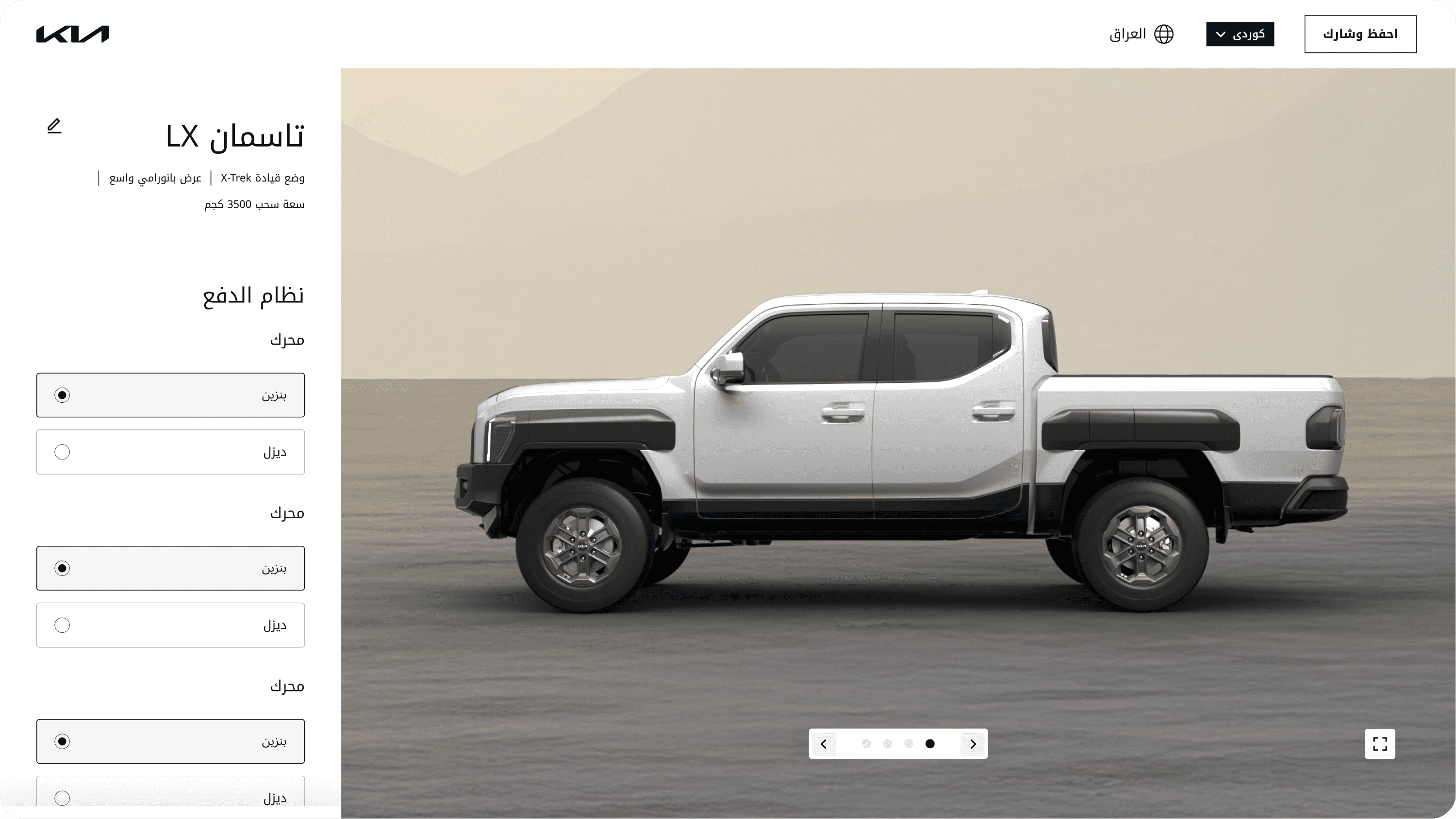
A Background That Felt Regional
A Background That Felt Regional
Most configurators use grey or nothing. Research had already established that these trucks live in a specific environment and carry specific associations here, so I pushed for a subtle regional background that placed Tasman in the Middle East. Internal team members disagreed. Kia loved it.
Most configurators use grey or nothing. Research had already established that these trucks live in a specific environment and carry specific associations here, so I pushed for a subtle regional background that placed Tasman in the Middle East. Internal team members disagreed. Kia loved it.
One Journey Across Two Surfaces
One Journey Across Two Surfaces
Consistent terminology, visual patterns, and interaction principles across both surfaces so users never felt the seam between them. Trim first, exterior second, interior third, accessories last. Biggest decisions when attention is highest.
Consistent terminology, visual patterns, and interaction principles across both surfaces so users never felt the seam between them. Trim first, exterior second, interior third, accessories last. Biggest decisions when attention is highest.
Bilingual From the Start
Bilingual From the Start
Every surface delivered in English and Arabic. Layouts and hierarchies rethought for right to left readers, not just mirrored.
Every surface delivered in English and Arabic. Layouts and hierarchies rethought for right to left readers, not just mirrored.
Microsite

Configurator
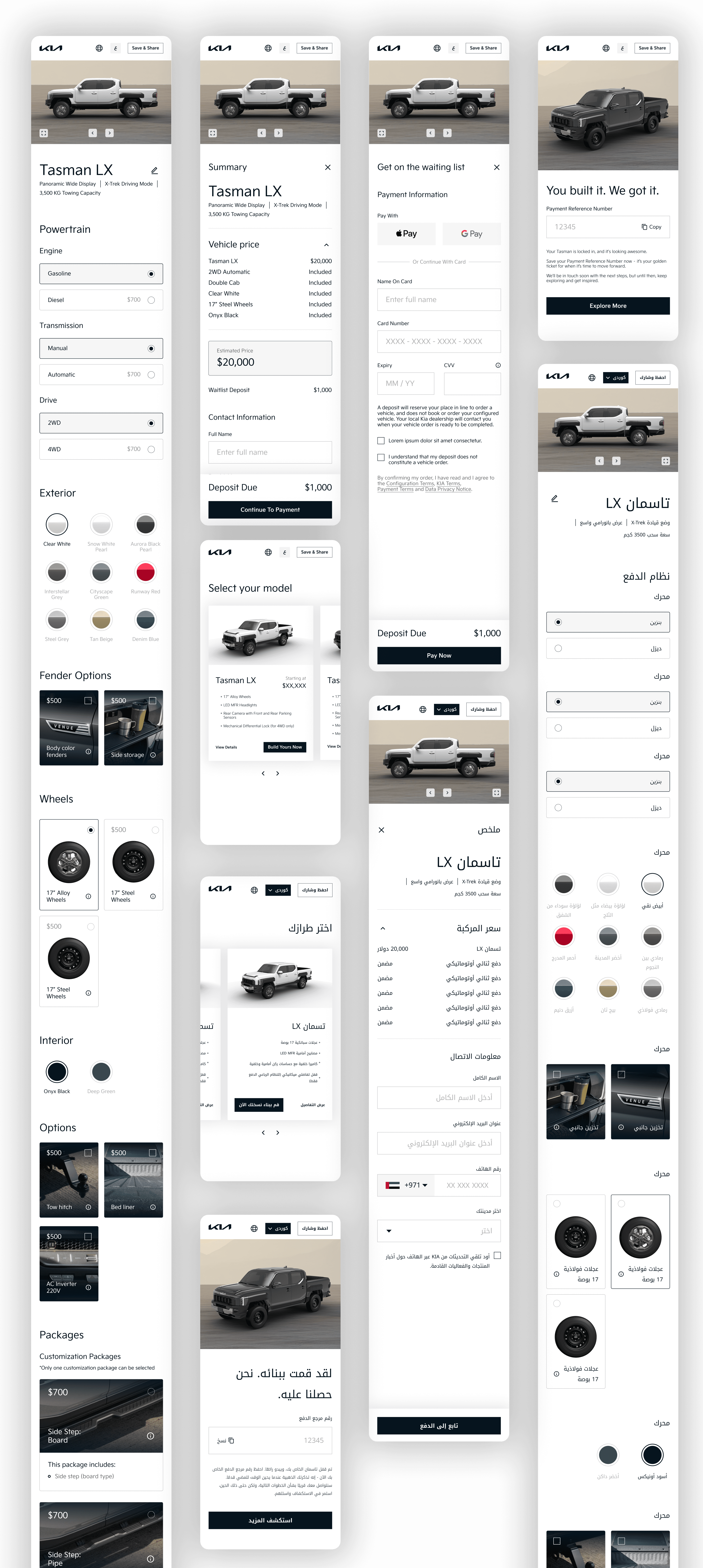
Validation
Once the prototype was ready, it was tested with real truck users from the region alongside stakeholders. The same audience that had shaped the research was the audience that pressure tested the result.
Sessions focused on whether the journey did its job, whether the microsite actually built enough conviction to carry someone into the configurator, and whether configuration itself held up for buyers who knew exactly what they wanted from a truck. Findings fed back into the designs before launch.
Once the prototype was ready, it was tested with real truck users from the region alongside stakeholders. The same audience that had shaped the research was the audience that pressure tested the result.
Sessions focused on whether the journey did its job, whether the microsite actually built enough conviction to carry someone into the configurator, and whether configuration itself held up for buyers who knew exactly what they wanted from a truck. Findings fed back into the designs before launch.
Outcomes
The launch delivered Kia's first regional pickup truck experience built entirely for the Middle East market. A component library meant 3D asset corrections from the parallel render agency could be swapped across the entire configurator in minutes rather than days. Two separate surfaces were designed with shared language, patterns, and flow so users moved from discovery to configuration without feeling the seam between them.
The launch delivered Kia's first regional pickup truck experience built entirely for the Middle East market. A component library meant 3D asset corrections from the parallel render agency could be swapped across the entire configurator in minutes rather than days. Two separate surfaces were designed with shared language, patterns, and flow so users moved from discovery to configuration without feeling the seam between them.
Learnings
Separating design decisions from asset availability keeps projects moving when dependencies are outside your control.
Briefing the 3D agency on jellybean structure early meant we never had to redesign the configurator architecture later. Understanding technical constraints changes the quality of decisions you make at the start.
The regional background reminded me that the most impactful suggestions are sometimes the ones that go against the obvious default.
Separating design decisions from asset availability keeps projects moving when dependencies are outside your control.
Briefing the 3D agency on jellybean structure early meant we never had to redesign the configurator architecture later. Understanding technical constraints changes the quality of decisions you make at the start.
The regional background reminded me that the most impactful suggestions are sometimes the ones that go against the obvious default.